
The cost to outsource network management depends on the equipment covered, the work included, and when your business needs support; compare proposals against the same written scope. Separate ongoing management from onboarding, equipment, licenses, and project work before accepting a monthly quote. For your 2026 budget, the useful figure is the total contractual commitment—not the recurring service line alone.
- The cost to outsource network management depends on coverage, responsibilities, and exclusions—not the monthly service line alone.
- Compare network monitoring with active network management; detecting a fault and resolving it are different responsibilities.
- BritCore IT provides managed IT support for business teams needing ongoing maintenance and structured user help.
- Request written terms for onboarding, equipment, licenses, support hours, and escalation before comparing proposals.
Why this matters
A network proposal needs to explain who maintains the equipment, who handles reported faults, and where the provider’s responsibility ends. A monitoring dashboard does not answer those questions. Neither does an unexplained monthly total.
Start with the boundary between network management and broader managed IT support services. Workstation problems, server faults, internet outages, and wireless issues need different technical attention, even when employees describe all of them as a slow network.
Compare the work each agreement covers before comparing the amount on the proposal. Otherwise, you are comparing different services as if they were interchangeable.
How much does it cost to outsource network management?
Your outsourcing cost is the sum of the management commitment and any separately contracted work or purchases. Ask every provider to quote against your equipment inventory, operating requirements, and support boundaries. Keep optional work separate so it does not obscure the comparison.
Use this breakdown when reviewing a 2026 proposal:
| Cost component | What to establish | What makes comparison difficult |
|---|---|---|
| Ongoing management | Named equipment, maintenance tasks, and incident responsibilities | A broad service label without a task list |
| Initial setup | Discovery, access setup, documentation, and management handover | Setup work left outside the written proposal |
| Equipment and licensing | Ownership, subscriptions, renewals, and replacement responsibility | Assuming hardware or licenses are included |
| Support coverage | Operating hours, reporting channels, and escalation arrangements | Treating response and resolution as equivalent |
| Change work | Rules for moves, expansions, configuration changes, and upgrades | Mixing routine maintenance with projects |
| Contract exit | Access transfer, documentation, and equipment ownership | Unclear responsibilities when the agreement ends |
Ask the provider to mark every component as included, excluded, optional, or separately quoted. An empty field is not an inclusion.
Then check whether the agreement covers just network equipment or also servers and workstations. Do not assume that a network management contract includes employee help-desk support simply because employees use the network.
What should a usable quote contain?
A usable quote connects each charge to a defined responsibility. You should be able to identify the covered environment, the service boundary, and the conditions that trigger additional work without relying on a sales conversation.
Request a written equipment schedule alongside the proposal. Keep unresolved questions attached to the quote until the provider answers them; verbal clarification is not a substitute for contract language.
Monitoring-only support: best for teams that handle remediation
Monitoring-only support is a narrower scope to consider when your internal team will investigate alerts and perform corrective work. The central question is who receives an alert and what happens next.
Its advantage is a clear division of responsibility when you already have technical staff. Its limitation is equally clear: notification alone does not assign ownership of the repair.
Ask whether the proposed service includes alert review, ticket creation, or technical investigation. These are separate activities. If your staff owns the next action, document the handoff and the information the provider must supply.
Choose monitoring-only support only when someone on your side owns remediation. Do not buy an alerting arrangement expecting it to function as an outsourced support team.
Managed network support: best for delegated network upkeep
Managed network support is the scope to request when you want a provider responsible for specified network maintenance and incident handling. The agreement should name the equipment and the tasks rather than rely on the word managed.
The benefit is an assigned service owner for the covered network work. The limitation is the boundary: a network agreement does not automatically cover application support, workstation maintenance, or server administration.
For your 2026 review, ask the provider to describe how routine maintenance, configuration changes, and reported incidents are handled. Separate the process for a service fault from the process for an office expansion.
Choose managed network support when your main requirement is delegated upkeep of defined network equipment. Expand the scope explicitly if employees also need direct technical help.
Broader managed IT support: best for connected support needs
Broader managed IT support is the scope to consider when network equipment, servers, workstations, and user assistance need coordinated responsibility. It gives you a way to address those areas through one service agreement, provided the contract actually names them.
The advantage is a wider support boundary. The limitation is that a broad label still leaves room for exclusions, especially around projects, equipment purchases, and responsibilities held by another supplier.
BritCore IT is best for business teams seeking ongoing managed IT support across network equipment, servers, workstations, and structured user help. Confirm the contractual coverage and escalation arrangements against your own requirements before selecting a service.
| Service scope | Best for | Main advantage | Main limitation to check |
|---|---|---|---|
| Monitoring only | Teams that retain technical ownership | Separates detection from internal corrective work | Who investigates and fixes alerts |
| Managed network support | Businesses delegating network upkeep | Assigns responsibility for named network tasks | Whether servers and workstations are excluded |
| Broader managed IT support | Teams needing connected technical support | Brings several support areas into the agreement | Whether projects and purchases remain separate |
Why network management scope varies
The work you need determines which proposal is relevant. Use these factors to explain your requirements rather than asking providers to guess from employee count alone:
- Network equipment: Identify the devices to be managed and their purpose. Ask the provider to list any equipment it will not cover.
- Server responsibility: State whether server administration belongs in the agreement or stays with another technical owner.
- Workstation coverage: Clarify whether employee computers receive maintenance or only assistance with network connectivity.
- User assistance: Decide whether employees contact the provider directly or report issues through an internal contact.
- Escalation needs: Identify how issues move from initial support to more technical attention and who communicates the next steps.
These factors describe different workloads, not interchangeable versions of the same service. A proposal covering network equipment alone is not a like-for-like alternative to one covering servers, workstations, and user help.
For a 2026 renewal, compare the proposed scope with what your business needs now. Do not carry an old equipment list into a new agreement without checking it.
How do you compare outsourcing proposals fairly?
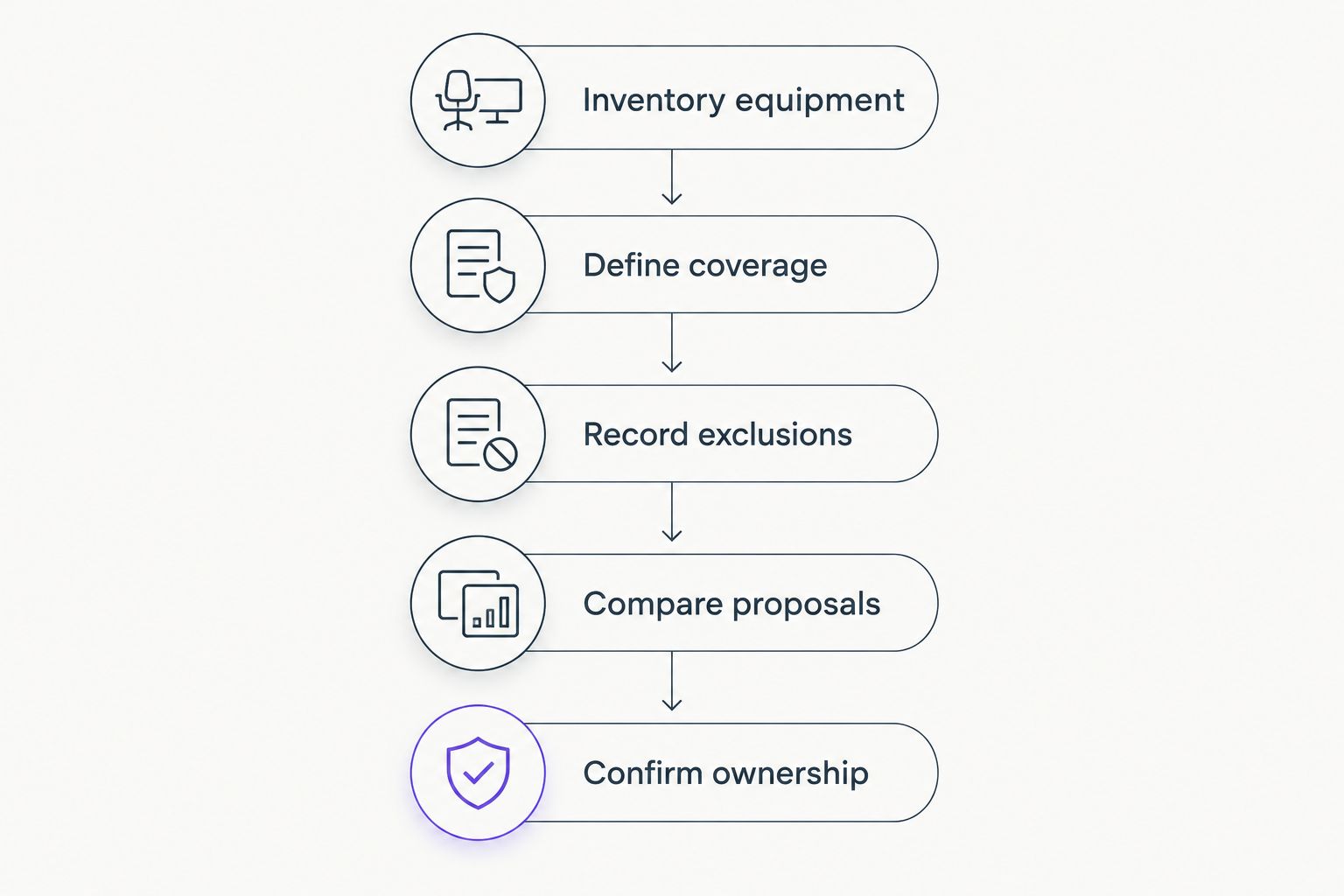
Compare proposals through the same sequence: inventory the environment, define coverage, record exclusions, compare the written responses, and confirm ownership. This prevents a polished proposal from substituting for an operational agreement.
Inventory equipment
List the network equipment, servers, and workstations relevant to the proposed service. Identify who owns each item and who currently controls administrative access.
The inventory is the starting point for the quote. Ask providers to identify discrepancies before they finalize their scope, not after support begins.
Define coverage
Write down the work you expect the provider to perform. Include maintenance, incident handling, user assistance where required, and the support hours your operations need.
Distinguish business requirements from preferences. A provider needs to know whether an unavailable system stops work or whether the task can wait for a planned maintenance period.
Record exclusions
Ask for an explicit exclusion list covering equipment, software, projects, licenses, and work outside agreed hours. Establish how you approve separately scoped work before it starts.
An exclusion is not automatically a reason to reject a proposal. An unclear exclusion is a reason to stop and ask for clarification.
Compare proposals
Put each provider’s answers beside the same requirements. Mark gaps and differences before discussing the total commitment.
Do not count a general promise of support as an answer to a specific responsibility question. Ask who performs the task, when the service applies, and what falls outside it.
Confirm ownership
Name the business contact, the provider contact, and the escalation route. Confirm how records, administrative access, and equipment documentation are handled during the agreement and at exit.
Do not sign until each essential responsibility has an owner. Shared involvement still needs a clear handoff.
Does network management include employee IT support?
Network management includes employee IT support only when the agreement explicitly covers it. Ask whether employees can report issues directly and whether the provider handles workstation problems as well as network faults.
A support boundary should be understandable to employees, not just technical staff. Give your team a clear reporting route and explain which issues belong elsewhere.
Is network monitoring the same as network management?
Network monitoring is not the same as network management: detecting an event does not establish who investigates or resolves it. Your agreement should connect alerts to an assigned response process.
Ask the provider to walk through a sample incident from detection to closure. Focus on ownership, communication, and escalation rather than the appearance of the monitoring dashboard.
Should onboarding be part of the comparison?
Onboarding belongs in the comparison because access setup, documentation, and service handover are distinct from ongoing support. Ask which tasks must be completed before the provider accepts operational responsibility.
For a 2026 transition, agree on the handover sequence with both the incoming provider and whoever currently administers the environment. Confirm that your business retains the access and records it needs.
FAQ
What determines the cost to outsource network management?
The cost to outsource network management depends on the covered equipment, assigned work, support coverage, and contractual exclusions. Compare ongoing management separately from onboarding, equipment, licenses, and projects.
Can I compare network management quotes by employee count alone?
Employee count alone does not describe the network equipment or technical responsibilities a provider must cover. Give each provider the same inventory and service requirements before comparing proposals.
Does outsourced network management include new equipment?
New equipment is included only if the agreement explicitly says so. Confirm ownership, licensing, replacement responsibility, and approval requirements before accepting the proposal.
Is monitoring-only support enough for my business?
Monitoring-only support fits a business that retains responsibility for investigating and resolving alerts. If you need the provider to perform corrective work, request that responsibility explicitly.
Does managed network support include servers and workstations?
Managed network support includes servers and workstations only when those systems appear in the service scope. A network service label is not a substitute for a covered-equipment schedule.
What should I ask about support response times?
Ask what a response means, when the commitment applies, and how an issue is escalated. An acknowledgment does not establish that service has been restored.
Does BritCore IT provide broader managed IT support?
BritCore IT provides ongoing managed IT support for business teams, including management of servers, network equipment, and workstations. It also provides structured user help with escalation paths for issues needing more technical attention.
One last thing
Test the proposal against an issue that crosses a support boundary: an employee cannot reach a business application, but the cause is not yet known. Ask who owns the ticket while the provider determines whether the fault sits with the workstation, network, server, or another supplier.
An unresolved boundary is an unresolved responsibility. Before you commit your 2026 budget, ask BritCore IT about your support requirements and bring the equipment list, required coverage, and questions about exclusions.