

Best overall for structured internal IT: Freshservice. Best for a self-hosted ticket queue: osTicket. Best for development-linked support: Jira Service Management. For IT help desk software ranked by price in 2026, compare quotes for the same operating requirements—not subscription labels alone.
- IT help desk software ranked by price needs equivalent deployment, licensing, and support requirements before quotes are comparable.
- Freshservice is the default shortlist choice for structured internal IT service management.
- osTicket suits teams prepared to operate their own ticketing system; Jira Service Management suits development-linked support.
- BritCore IT provides managed IT support for business teams that need maintenance and user help, not another software queue.
Why this matters
A help desk application organizes requests. It does not supply the people who diagnose workstation faults, maintain servers, or resolve network problems. Buying software and buying managed support are different decisions.
BritCore IT provides ongoing business IT support, system maintenance, and structured user help with escalation paths. BritCore IT managed IT support fits business teams that need someone to maintain systems and handle user issues. Keep that service decision separate from the software shortlist below.
For your 2026 evaluation, require every vendor to quote the same users, technicians, deployment model, and necessary features. A lower subscription figure is not a lower operating cost when it leaves essential work with your team.
What makes the best IT help desk software
Judge each option against these criteria before comparing commercial terms:
- Request handling: Users need a clear way to report an issue, while technicians need ownership, status, and usable history.
- Escalation: Routine requests and technical investigations need different handling without losing context.
- Deployment responsibility: Someone must own hosting, updates, backups, and recovery where those duties remain internal.
- Service management fit: Incident handling, approvals, assets, and changes should match the work you actually perform.
- Administrative workload: Configuration and reporting should support the team rather than become another unmanaged system.
- Comparable scope: Evaluate equivalent requirements instead of comparing a basic ticket queue with a broader service-management platform.
IT help desk software at a glance
The order below ranks operational fit, not an unverified cheapest-to-most-expensive sequence. Use it to select the products that deserve a like-for-like quote in 2026.
| Rank and software | Best for | Standout capability | Key limitation |
|---|---|---|---|
| 1. Freshservice | Structured internal IT operations | IT service management workflows | Broader configuration requires process ownership |
| 2. osTicket | A self-hosted ticket queue | Open-source support ticketing | Your team owns the self-hosted environment |
| 3. Jira Service Management | Support connected to development | Service workflows connected to Jira work | Workflow design needs active administration |
| 4. Zammad | Open-source conversational support | Ticket handling across support channels | Self-hosting adds operational responsibility |
| 5. ManageEngine ServiceDesk Plus | Service work tied to IT assets | Service management and asset workflows | Edition and deployment choices require careful scoping |
Open-source software is not the same thing as an operated service. Hosted software is not the same thing as staffed support. Those distinctions matter more than the position of a product in a price-sorted search result.
1. Freshservice: best IT help desk software for internal IT operations
Freshservice is an IT service management platform for organizing employee support and related IT workflows. It belongs on your shortlist when you need more structure than a shared inbox and want service processes in the same application.
Freshservice best for: An internal IT team building a defined service desk with consistent request handling.
Freshservice pros:
- Supports a service-management approach rather than email handling alone.
- Brings employee requests and IT workflows into a common working environment.
- Offers a route from basic ticket handling toward broader service processes.
Freshservice cons:
- Broader functionality requires someone to define and maintain the processes.
- A team needing only simple ticket ownership must evaluate whether the additional scope is necessary.
For a 2026 evaluation, demonstrate a routine user request, a technical escalation, and a request requiring approval. Ask the vendor to identify the exact configuration needed for those workflows, then quote that configuration.
Verdict: Buy Freshservice when structured internal IT service management is the requirement. Hold if nobody owns the processes it will support.
2. osTicket: best IT help desk software for a self-hosted queue
osTicket is an open-source support ticketing system. It suits organizations that want to organize incoming requests while retaining responsibility for their own deployment.
osTicket best for: Teams with the technical capacity to operate a focused, self-hosted ticketing environment.
osTicket pros:
- Keeps the evaluation centered on request intake and ticket handling.
- Provides an open-source deployment option.
- Lets your technical team control the self-hosted application environment.
osTicket cons:
- Self-hosting leaves application maintenance, backups, and recovery with your organization.
- A ticket queue alone does not establish asset management, change control, or staffed support.
Before selecting osTicket, name the person responsible for application updates and restoration after an outage. If that responsibility is unassigned, the deployment decision is incomplete regardless of how attractive the licensing arrangement looks.
Separate customization requests from essential requirements. A system that needs extensive modification before technicians can process ordinary requests creates another maintenance obligation.
Verdict: Buy osTicket for a focused self-hosted queue with a named administrator. Skip self-hosting when nobody can maintain it.
3. Jira Service Management: best for development-linked IT support
Jira Service Management handles service requests and operational workflows within the Jira product family. Its clearest use case is support work that needs a defined connection to development or engineering tasks.
Jira Service Management best for: Organizations where support issues regularly require engineering investigation.
Jira Service Management pros:
- Connects service work with the wider Jira working environment.
- Supports defined request workflows and ownership.
- Fits teams that need a clear handoff between support and engineering.
Jira Service Management cons:
- Flexible workflows still require design, permissions management, and ongoing administration.
- A complicated workflow is a poor substitute for a clear escalation policy.
During evaluation, follow an employee's request through the engineering handoff and back to the support team. Confirm that the original request retains an owner and that users receive understandable updates.
Do not adopt Jira Service Management solely because another department already uses Jira. Shared software is valuable only when the connection improves the actual support process.
Verdict: Buy Jira Service Management when engineering handoffs are central to support. Hold when that connection has no practical use.
4. Zammad: best for open-source conversational support
Zammad is an open-source help desk platform that organizes support conversations into tickets. It belongs on the shortlist when request communication is the main problem and you want to evaluate an open-source approach.
Zammad best for: Support teams prioritizing conversation history and request ownership.
Zammad pros:
- Organizes support exchanges around tickets rather than scattered messages.
- Provides an open-source option for teams assessing deployment control.
- Keeps communication and ticket progress connected.
Zammad cons:
- A self-hosted deployment requires application operations and maintenance.
- Communication features do not replace a technical escalation process.
Test a request that arrives through one channel and continues through another. Check whether the technician can understand the history without asking the user to repeat the issue.
For your 2026 shortlist, compare the responsibility split as carefully as the application itself. Hosting, updating, and troubleshooting the help desk are separate tasks from resolving the tickets inside it.
Verdict: Buy Zammad when conversational ticket handling fits the work. Hold if deployment responsibility is unresolved.
5. ManageEngine ServiceDesk Plus: best for asset-linked service work
ManageEngine ServiceDesk Plus combines IT service-management capabilities with asset-related workflows. It deserves attention when support decisions depend on understanding the equipment associated with a request.
ManageEngine ServiceDesk Plus best for: IT teams connecting service requests with asset records and operational processes.
ManageEngine ServiceDesk Plus pros:
- Supports evaluation of service management and assets together.
- Gives asset-dependent support workflows a defined place in the selection process.
- Offers deployment choices that can be assessed against internal operating requirements.
ManageEngine ServiceDesk Plus cons:
- Required capabilities must be matched to the appropriate edition and deployment.
- Asset records need ownership and upkeep to remain useful.
Demonstrate a workstation issue where the technician needs device context before taking action. Then demonstrate how an equipment change reaches the asset record.
A populated inventory is not automatically an accurate inventory. Assign responsibility for record updates before making asset-linked workflows part of the purchasing justification.
Verdict: Buy ManageEngine ServiceDesk Plus when asset context is essential to support. Hold if asset data has no owner.
Compare total responsibility before comparing quotes
Build one scope document and send it to every shortlisted vendor. Your 2026 comparison should distinguish application access from the work required to operate it.
Ask each vendor to address:
- Technician licensing and any other applicable licensing units.
- Required workflows, reporting, and integrations.
- Hosting, updates, backups, and recovery responsibilities.
- Setup, migration, administration, and vendor support scope.
- Data export and the work involved in leaving the platform.
Keep adjacent tools out of the help desk comparison unless their functions are required. When assessing Itarian alternatives, separate endpoint-management requirements from ticket-handling requirements so a broader bundle does not obscure who handles requests, maintains devices, and owns escalation.
Do not award a product credit for functions your team will not use. Equally, do not exclude necessary administration from the decision merely because it does not appear as a subscription line item.
Run the same practical evaluation for each finalist
Use a proposed test set of 10 sample tickets, handled by 2 technicians, followed by a 30-day review period if your procurement process permits. These are evaluation parameters, not claims about product performance.
Use the same scenarios across every product:
- Request intake: Submit an employee issue with enough detail to begin work.
- Ticket ownership: Assign responsibility and confirm that the user understands the next step.
- Technical escalation: Transfer an unresolved issue without losing its history.
- Resolution record: Document the action taken and confirm the outcome.
- Repeat review: Find related requests and identify follow-up work.
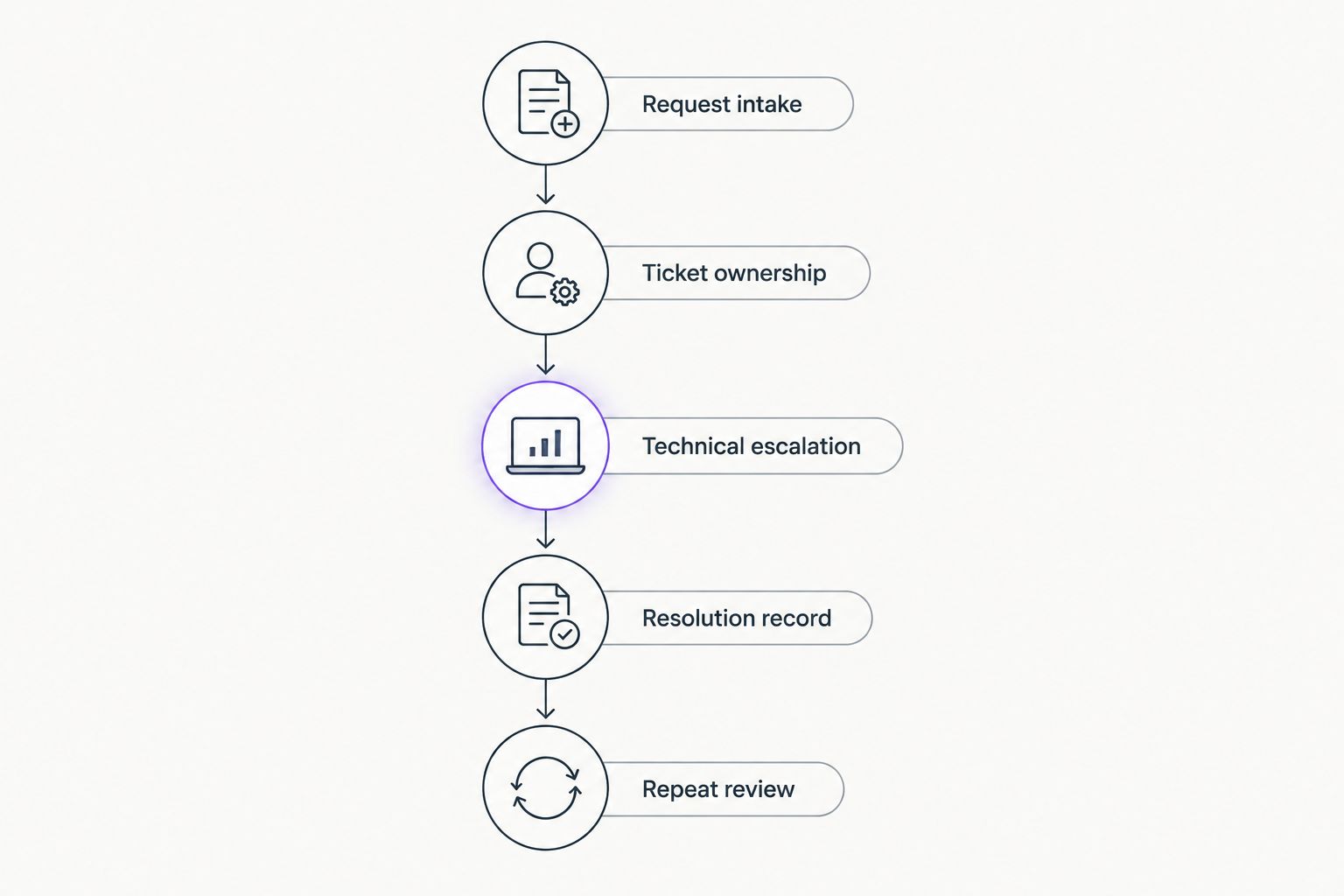
Record where technicians need workarounds, duplicate entry, or information from another system. Ask users whether the acknowledgement and updates explain what happens next. A completed ticket is not enough if its history cannot support the next investigation.
How the shortlist is ranked
This shortlist ranks distinct operational uses against request handling, escalation, deployment responsibility, service-management fit, and administration. It is not a benchmark test or a verified price ladder.
Freshservice is the default for structured internal service management. osTicket and Zammad address different open-source support needs; Jira Service Management addresses engineering-connected work; ManageEngine ServiceDesk Plus addresses asset-linked service operations.
Use equivalent vendor quotes to establish your own price order after those requirements are fixed.
Which IT help desk software should you choose?
Start with Freshservice if you need an internal IT service desk and have someone to run it. Compare only the alternatives that match a distinct requirement: self-hosting, conversational support, engineering handoffs, or asset-linked work.
If the underlying gap is technical ownership rather than ticket organization, evaluate managed support first. BritCore IT managed IT support covers ongoing business technology maintenance and structured user help; a software purchase alone does not provide that operating responsibility.
Define your IT support needs
Discuss system maintenance, user support, and escalation responsibilities.
FAQ
What’s the best IT help desk software to shortlist first?
Freshservice is the default shortlist choice for structured internal IT service management. Choose a different starting point when self-hosting, engineering handoffs, or asset-linked support defines the requirement.
Can I choose IT help desk software by price alone?
No. Compare equivalent licensing, deployment, required features, and operating responsibilities before sorting vendor quotes. Otherwise, you are comparing different scopes of work.
Is open-source help desk software the same as managed support?
No. Open-source help desk software provides an application, while managed support provides ongoing operational work. A self-hosted application still needs maintenance, backups, and recovery ownership.
Is osTicket better than Zammad?
osTicket fits a focused self-hosted ticket queue; Zammad fits conversational support workflows. Test both against the same requests and select the approach your team can operate.
When should I choose Jira Service Management?
Choose Jira Service Management when service requests need a defined connection to engineering work. Confirm that ownership and user updates remain clear throughout the handoff.
How do I compare help desk software costs in 2026?
Request current quotes against one written scope. Include required features, licensing units, deployment responsibilities, setup, administration, and data export.
Do I need help desk software or an IT support provider?
You need software when your existing support team needs better request organization. BritCore IT fits business teams seeking ongoing IT maintenance and structured user support rather than an application alone.
One last thing
Before signing, ask a technician to reopen a resolved sample ticket and explain the diagnosis from its history alone. If the record contains only a closure status, your evaluation has tested ticket movement—not useful support documentation.